Nothing stays buried.
Every dependency leaves a trail.
Understand the SQL and SAS pipelines in front of you. Follow a table’s dependencies all the way back to the original statements, in a workspace that keeps your source local.
Build your first lineage Explore the guides
Local storage. No LLM required. Imported code is never executed.
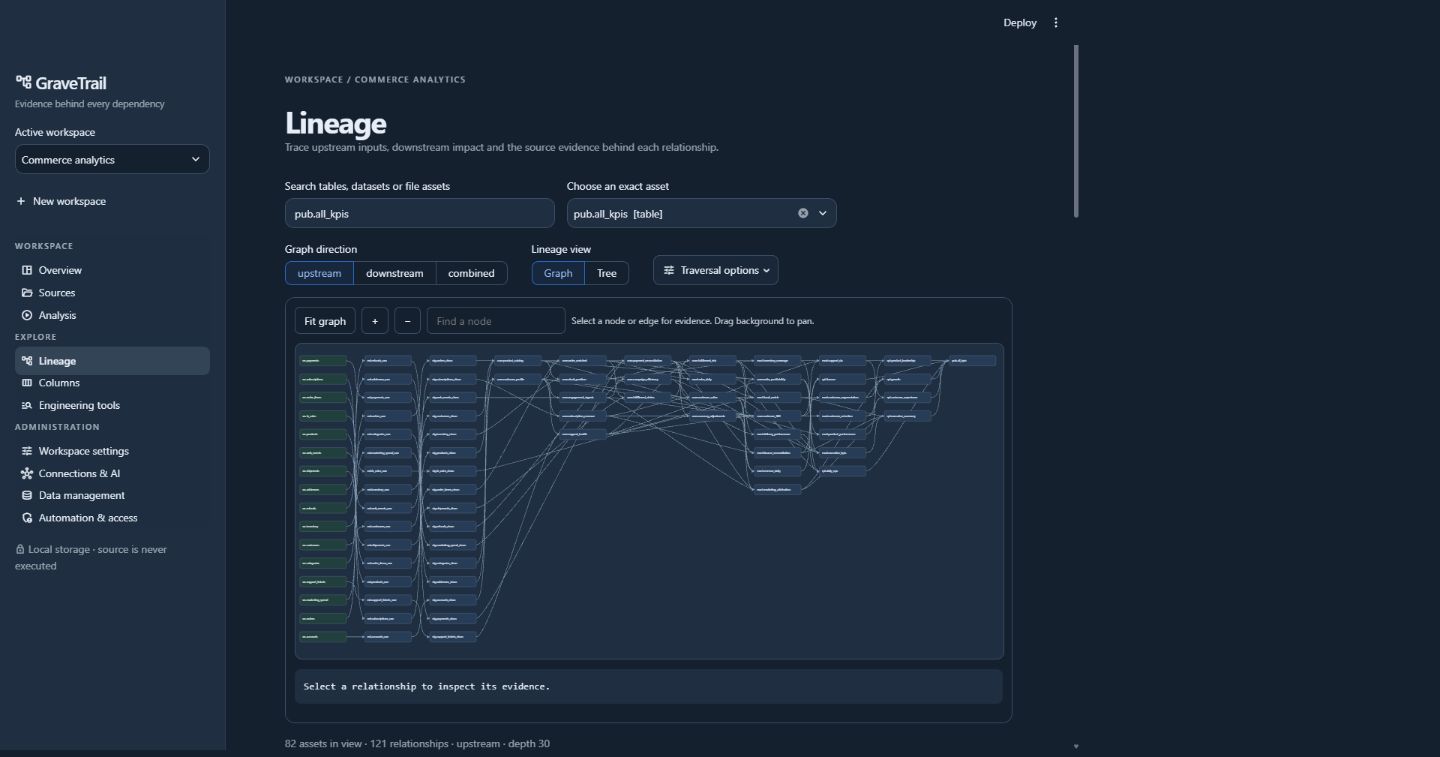
Begin with the question in front of you
Where does this table come from?
Follow upstream dependencies across persistent tables and temporary stages. Open a relationship to inspect the original statement and line range.
What depends on this change?
Trace downstream impact, inspect direct column usage, and search related source. Follow output expressions in the separate Transformation lineage view, with original evidence and explicit SQL/SAS coverage boundaries. Export an offline graph or a report to share your findings.
How can my tools use the evidence?
Query stored analysis through the CLI or MCP with explicit permissions, freshness metadata and bounded responses. Optional AI stays behind your privacy controls.
A useful first run, on your machine.
Install from source with Python 3.11+ and uv.
Try an included SQL or SAS project, then trace pub.all_kpis through seven dependency layers.
git clone https://github.com/SahasilAK/GraveTrail.git
cd GraveTrail
uv sync --locked --extra dev
uv run gravetrail-ui
Using pip, Docker or a native bundle? Read the installation reference for supported workflows and verification limits.
A place for every part of your work
Import in Sources, run Analysis, then investigate in Lineage, Columns or Engineering tools. Workspace preferences, AI connections, data management and automation each have a focused destination.
Getting started Workspace and UI reference Architecture and parsing coverage Integrations and privacy Deployment and recovery Development and testing Troubleshooting Contributing
Follow the evidence, including its limits
GraveTrail performs static analysis. Unsupported syntax, dynamic macros and ambiguous identities remain diagnostic boundaries. AI-assisted relationships remain inferred after validation and explicit merge. Read the SQL and SAS coverage before drawing conclusions from missing edges.